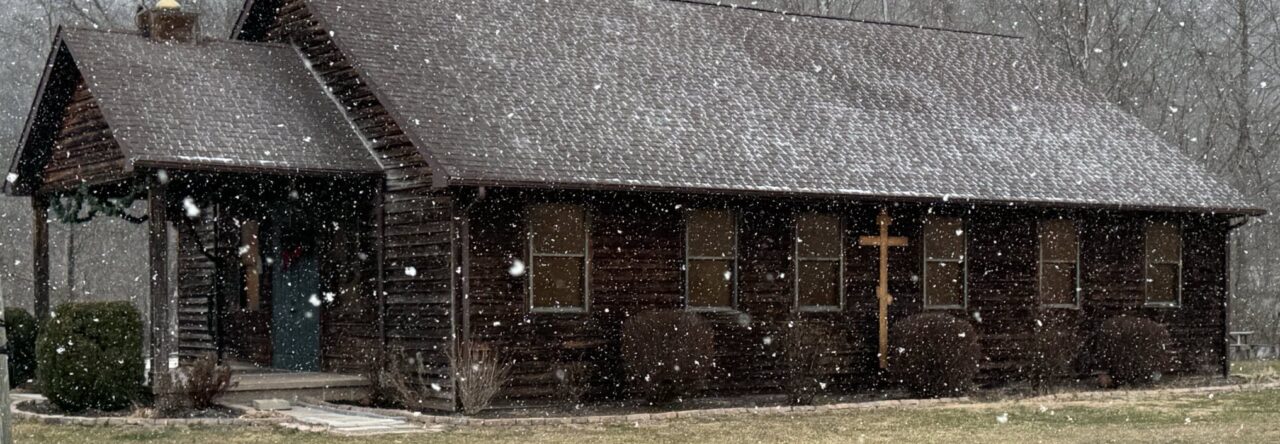
Christ the Savior Orthodox Church

A Parish of the Russian Orthodox Church Outside of Russia located in Wayne, WV

Modern Orthodox Saints and Holy Fathers & Mothers: Archbishop Andrew of Rockland

Born Adrian Rymarenko, on March 15/28, 1893, he was raised in a wealthy and pious family in the town of Romny, Poltava province, Ukraine. He recollects,

“I grew up in a pious family… I was surrounded by that Orthodox way of life which for generations had been created by Holy Russia. In our family, life proceeded according to the church calendar, according to the yearly church cycle. Feast days were as it were the signposts of life. At home there were constant Divine services, and not only molebens, but all-night vigils also.

“… When I remember those years there inevitably rises before me an unforgettable picture: early morning, it’s still dark. I have only just woken up and I see in front of the icons, half-illumined by a lampada, my mother. She prays for a long time. But a still stronger impression was made on me by the early-morning Divine services, to which our mother often took us and to which we went no matter what the weather, autumn or winter! After these Divine services one always felt a kind of extraordinary inspiration, a kind of quiet joy.”[1]

He recalls that this way of life was not only characteristic of his family but of all society around him. Following the Revolution of 1905 all this changed. He says that peoples’ joy was now replaced with “disillusionment and desolation.” During this time he attended the St. Petersburg Polytechnical Institute and studied engineering where those all-pervading feelings of despair started to affect him. During this time he found his soul to cry out: “I cannot.” He says,

“I felt that I could not live as people around me were living. I felt that I was lacking that life, the Orthodox way of life, which had surrounded me in my childhood and youth, that lightness of heart which I felt. I had the impression that I had been deprived of the air which I had breathed.”[2] From this moment on he started to seek out ways to revive this in his life.

This new life was given to him in the person of Archpriest John Egorov who was the leader of a student group. He spent five years under the tutelage of this Archpriest and found opened up to him the “elemental reality of the life of Christ’s Church by which Holy Russia lived.”[3] Of this “elemental reality” which was imparted to him, he says, “I understood that the Divine services are not merely a ritual, but in them are revealed the dogmas of the faith. They are the foundations of man’s reception of Divinity. Then, the examination and study of the works of the Fathers of the Church and the Patrisitic writings revealed to me the paths of life. When I had gone through the whole course taught by Fr. John, I had literall come back to life. I sensed the elemental power of Orthodoxy, I sensed the breath of life which it gave. I understood in what this life consisted.”[4]

After this time he went to Optina where he met the Elder, Anatoly the Younger in 1921. At this time Eugenia Grigorievna was now in his life and she had gone to Optina before him to resolve questions about their marriage
and his priesthood. Fr. Anatoly blessed both of these decisions and later in the summer Adrian came to ask more questions about the same subjects.


Matushka Eugenia Rymarenko was the daughter of prominent landowners in the province of Poltava. She studied in St. Petersburg and later transferred to Moscow. She had slowly moved away from the Church but after the death of her parents and her experiences connected with the Revolution she returned to the city of Romny, in the province of Poltava. There she met her future husband who had given her several religious books and inspired her to go to Optina. In recalling her first visit to Optina Monastery, she said: “Why I went to Fr. Anatoly at that time, I do not know. I had almost no understanding of eldership. I had only read Lodyzensky’s Trilogy: Higher Consciousness, Light Invisible and Dark Forces and Sergei Nilus’ book On the Bank of God’s River. Actually I wanted to visit the elder in order to get a look at him and hear from him some prediction of the future… Instead of a prediction of the future, I experienced joyful moments of repentance, and an unusual, peaceful state of mind and submission to the will of God. I was so won over by Batyushka that later, it was enough just to think of him in order to acquire a peaceful, bright state of mind.”[5]He describes his first meeting with the Elder thusly: “I arrived at Optina on the day of SS. Peter and Paul at 6 o’clock in the morning, and stayed at the guest-house with the wonderful Monk Theodulus. He told Fr. Eustignius, Fr. Anatolius’ cell-attendant, that I had come. Batyushka immediately sent for me and blessed me to come to him after the Liturgy. Vladyka Micah celebrated the Liturgy. The service in the church of the Entrance was triumphant, and after the service I immediately went to Batyushka. There was a whole crowd of people around Batyushka’s house. They were mainly nuns. I was immediately let through and went to the Elder… He was friendly and affectionate. In one moment I completely forgot about what I had only just seen: through his questions the whole of my life was handed over to him. The conversation was mainly about my inner life. We talked about my pastorship. Feeling my unworthiness, I asked the Elder to forbid me to think of the priesthood, to which he, just like Elder Nectarius later, said to me: ‘Accept the priesthood without fail, otherwise you will suffer.’ When Batyushka asked me about my life, he suddenly said to me: ‘Go to the holy things in the holy corner.’ There he began to read the prayers of confession, and I thought that I would do confession, but Batyushka summarized everything that I had said, I confirmed my sinfulness, and he read the prayer of absolution. This was for me an unexpected prayer, I felt that I was reborn.”[6]In 1921, Fr. Adrian began his pastoral duties in his native Romny at the Church of Alexander Nevsky. One of his parishioners describes this time of being surrounded by social unrest and the closing of churches. He says that Fr. Adrian served with feeling and that his sermons ignited the hearts of their listeners. Even though churches and monasteries were being closed this church was being filled with people. In no other church was there found such a spiritual life and devotion.[7]In 1926 the church in Romney was closed and Fr. Adrian was sent to Kiev where he was “under surveillance.” He says that at the beginning of this time there was very difficult but then he became close to a group of “pastor-ascetics” whom he described as his instructors and friends. In them he found the same preservation of that which he had longed for from back in his childhood. “All of them gave up their lives for what was already in my heart.”[8] And they literally did. “With these clergy there went to prison, exile and death thousands of their flocks, who wanted to live in God and with God. On my shoulders lay the heavy responsibility of continuing the work of the martyred ascetics…”[9]After the repose of Elder Anatoly of Optina Matushka Eugenia and Fr. Adrian became the spiritual daughter of Elder Nektary of Optina. They came often to visit and stay for weeks with the Elder. The Elder would often tell Matushka, “[Fr. Adrian] is full of Orthodoxy… I rejoice that [Fr. Adrian] is fully Orthodox,” and often spoke of him “with such affection.” Matushka had more time to stay due to Fr. Adrian’s responsibilities in the parish. She would often read to the Elder as well as write correspondence for him and copy various passages from books.

Elder Nektary of Optina

During his time in Kiev, Fr Adrian says that God had mercy on him and spared him from prison but this was only at the present time. In 1929 he was imprisoned for a short term then released and continued his priestly duties, though much more cautiously due to being closely monitored by the government.

As the Revolution in Russia progressed and Optina was slowly being liquidated Fr. Nektary was evicted from the monastery and came to live in a home in the village of Holmische in Briansky Province with a widower and his two boys. Here Matushka and Fr. Adrian would visit often until the Elder’s repose. For this Matushka would not be there but the Elder told her that Fr. Adrian would be and he was. Fr. Adrian left at two o’clock in the morning and, after much difficulty, arrived at four in the afternoon on April 29, 1928 on the day of the Elder’s repose. After his arrival, Fr. Adrian was present to read the Psalter for the Elder while he lay on his bed. As others were helping in assisting to turn the Elder in his bed icons of the Great-martyr Panteleimon and Saint Seraphim were brought from the reception room. One young lady said to the Elder, “Batyushka, bless Father Adrian with this.” With difficulty Batyushka reached out his hand, took the icon and put it on Father Adrian’s head. Then Father Adrian asked Batyushka to bless his whole family with the icon of Saint Seraphim. Shortly thereafter the Elder became unconscious. In her recollections of Elder Nektary, Matushka Eugenia says that when the Elder’s condition changed, “Father Adrian saw that Batiuhka indeed was dying. He read the Canon for the Departure of the Soul; Batyushka was still alive. Falling on his knees, Father Adrian pressed himself to him, to his back under his mantle. Batyushka was still breathing for a little while, but his breaths became fewer and fewer. Seeing that Batyushka was dying, Father Adrian rose from his knees and covered him with the epitrachalion. After a few minutes Batyushka passed away. It was 8:30 on the evening of April 29, 1928.”[10]

While serving the flock in Kiev the Soviets were soon to invade and Fr. Adrian and those who were close to him fled to Germany where he was made Rector of the Resurrection Cathedral in Berlin. Here they faced constant bombings but nonetheless the Divine services were held every day in the cathedral. From here the small group was evacuated to the south of Germany in Würtemberg. Here, as in Berlin, a small group of people would gather, under Fr. Adrian’s guidance and a church was built and they immediately began to perform the Divine services, in each place building the Orthodox way of life which was surrounded by the confusion of a foreign land. About these communities that would grow up in Kiev, in Berlin and now in Würtemberg Fr. Adrian says, “Many at first looked on us as naïve people who did not live in accordance with the times. But we lived, we lived in God. Little by little attitudes towards us changed. Pilgrimages began. People who had come to the depths of despair acquired amongst us peace of soul and a quiet joy, and went away enlightened and in peace.”[11]

The next move was now to be to America. In 1949, Fr Adrian came with a small group of Russia immigrants and settled one hour north of New York City in Nayack in Rockland County. In the Fall of the same year, Archbishop Vitaly of Jordanville and Archbishop Nikon asked that Fr. Adrian establish a women’s monastery to gather together nuns that had been scattered throughout the Diaspora and to establish the Orthodox way of life in this remote area. Fr. Adrian says that not only nuns but a significant number of the thousand displaced persons from Europe, came to settle around the monastery and became a large Orthodox family.[12]

Ivan Andreyev and Fr. Adrian (Rymarenko) in front of Novo-Diveevo cemetery. Spring, 1960

Regarding this new settlement, Fr Adrian said, “It is not yet enough to establish a monastic life; one must preserve it. For there is always the danger that life can be converted into a hothouse, a greenhouse, where it will be supported by artificial warmth, and as soon as the source of warmth ceases to operate, life will perish.

“Therefore there must be a constant source of life. Just as the earth and its vital juices constantly nourish vegetation, so our life also must be ceaselessly nourished by that elemental power which the Church of Christ gives, which is incarnated in the Orthodox way of life, in the Divine services, in fasting, in prayer, in vigils, in all that which embodies our Holy Russia. This is the elemental power which places in the mouth of the man who is leaving his earthly existence the last words, ‘Into Thy hands I commend my spirit’, and gives him the possibility to depart into eternal existence with the name of Christ.”[13]

Eugenia Grigorievna Rymarenko(1963)

In 1968, Matushka Eugenia reposed in the Lord and in 1973, Fr. Adrian was elevated to the dignity of Archbishop. As an Archbishop, Vladyka Andrew continued to live in Novo Diveyevo. He was the spiritual father of Metropolitan Philaret, and counseled many other members of the Church, both Russian and English-speaking.[14]

“The last day in the life of Vladyka Andrew was the feast of the Holy Apostles Peter and Paul. The weather was hot. He received Communion reverently, as he did on all Sundays and feastdays. He was very weak, and lay down surrounded by the people most devoted to him, waiting for the long-awaited hour.

“Every day he listened to three akathists: the first, to the Vladimir icon of the Mother of God, was read by Mother Nonna, the second, to St. Nicholas, was read at midday, and the third, to St. Seraphim, was read in the evening. He listened to all the services through a microphone that was connected to the church.

“In the evening, towards the end of Matins, Vladyka was praying with particular fervor to the Mother of God. He took out an icon that had been given to him by his mother and which he always carried. On this day he prayed before it with special intensity, with all his might. This was felt by everybody.

“Blood started to flow. His son and Fr. Alexander were worried. Brother Michael began to read the akathist to the Vladimir icon. Then Vladyka called everyone to say goodbye to them and to give them his last blessing. He said that he was dying and asked everyone to pray for him. And then he began fervently to cry out: ‘Most Holy Mother of God, save me!’ with other prayers. When a cold sweat came out on his face, he cried: ‘I am dead!’ and became white as snow.

“Fr. Alexander ran into the neighboring room to get hold of his epitrachelion – the same under which Elder Nectarius had died fifty years before. But Vladyka Andrew had already left this world.

“It was 11 p.m. on the feast of Sts. Peter and Paul, the same day on which Vladyka had entered Optina for the first time.”[15]


The authors of The Orthodox Word wrote an article about Archbishop Andrew in 1975 describing him as a “living link with the Holy Fathers”[16] a term used to describe that tradition which is the teaching of the Church throughout history that is embodied by certain grace-filled individuals. This article describes Archbishop Andrew’s contribution to the larger Orthodox world as a guide to “how to survive as an Orthodox Christian in the anti-Christian 20th century.”[17] Interesting to note is that it is not his homilies, or of books written but is instead his whole life. It is noted that he suffered much, in various countries, during war times, in prisons and exile. Others have gone through the same, especially during this period of time but their results have been fruitless. With Archbishop Andrew wherever he was a “close-knit Orthodox community” always formed around him. These authors attribute it to the presence of a “conscious Orthodox philosophy of life.”[18] This philosophy, not being an abstract systematization but instead a life lived by Archbishop Andrew is summarized in five points.

1) Orthodoxy is not merely a ritual, belief or pattern of behavior. Instead it is an “elemental power or reality which transforms a man and gives him the strength to live in the most difficult and tormenting conditions, and prepares him to depart with peace into eternal life.”[19]

2) The essence of the Orthodox life is “godliness” (piety) which is deeper then merely right doctrine. It is the entrance of God into every aspect of life.

3) This attitude produces the “Orthodox way of life” which is not so much outward customs or behaviors but the whole of the “conscious spiritual struggle of the man for whom the Church and its laws are the center of everything he does and thinks. The shared, conscious experience of this way of life, centered on the daily Divine services, produces the genuine Orthodox community, with its feelings of lightness, joy and inward quietness.”[20]

4) “Without a constant and conscious spiritual struggle even the best Orthodox life or community can become a ‘hothouse,’ an artificial Orthodox atmosphere in which the manifestations of Orthodox life are merely ‘enjoyed’ or taken for granted while the soul remains unchanged, being relaxed and comfortable instead of tense in the struggle for salvation.”[21]


[1] Vladimir Moss: Orthodox Christianity Author, s.v. “The Golden Chain: The Lives of Archbishop Theophan of Poltava, Archbishop John of San Francisco, Archbishop Joasaph of Canada, Archbishop Andrew of Rockland and Metropolitan Philaret of New York” (by Vladimir Moss), http://www.orthodoxchristianbooks.com/downloads/300_THE_GOLDEN_CHAIN.pdf.

[2] Archbishop Andrew of Nove-Diveevo, The One Thing Needful. (Liberty, TN: St. John of Krondstat Press, 1991), 6.

[3] Ibid.

[4] Ibid., 6-7.

[5] Matushka Eugenia Rymarenko, Reminiscences: Recollections about Elder Nektary of Optina. Mary Crockwell trans. (Jordanville, NY: Printshop of St. Job of Pochaev, 1993), 5.

[6] The Golden Chain.

[7] Википедии — свободной энциклопедии s.v. “Андрей (Рымаренкоhttp://ru.wikipedia.org/wiki/%C0%ED%E4%F0%E5%E9_(%D0%FB%EC%E0%F0%E5%ED%EA%EE)

[8] The One Thing Needful, 7.

[9] The Golden Chain.

[10] Matushka Eugenia Rymarenko, Reminiscences: Recollections about Elder Nektary of Optina. Mary Crockwell trans. (Jordanville, NY: Printshop of St. Job of Pochaev, 1993), 40.

[11] The Golden Chain.

[12] The One Thing Needful, 9.

[13] Ibid., 9-10.

[14] The Golden Chain.

[15] Ibid.

[16] The Brotherhood of St. Herman of Alaska, “Our Living Links with the Holy Fathers: Archbishop Andrew of New Diveyevo,” The Orthodox Word July-August (1975): 135.

[17] Ibid.

[18] Ibid., 136.

[19] Ibid.

[20] Ibid.

[21] Ibid., 136-137.

The 2012 Annual Parish Meeting was held

On Sunday, September 9th, the 2012 Annual Parish Meeting was held during which a new 9 member Parish Council was elected.  The new council consists of the following:

  • Fr Jonah Campbell: Rector and President
  • Brendan Thompson: Warden
  • Subdcn. Matthew Long: Secretary
  • Anthony Hudak: Treasurer
  • Annie Long: Head Sister
  • Rdr. Victor Lahnovych
  • Joachim Allen
  • Anna Allen
  • Anna (Anita) Hay

Beginning immediately, Parish Council meetings will be held the 3rd Sunday of each month.  The next parish council meeting will be held this Sunday, September 16th.

Several other important items were discussed including the following:

  • The 2012 budget was unanimously approved
  • We are planning for a festive 10th anniversary celebration to be held sometime later this year
  • Monthly potlucks are resuming beginning this month along with short presentations at each potluck on the “Lives of the Saints”
  • A fundraising brainstorming evening will be held in the near future to brainstorm fundraising ideas
  • Christ the Savior Church is actively seeking ways to provide charitable outreach to the surrounding community
  • Beginning next Sunday (September 16th), children will be dismissed during the singing of Psalm 33 to attend Sunday School
  • Parents are reminded to bring children to the front of the church during the final blessing with the chalice (i.e. when the priest says, “Always, now and ever and unto the ages of ages”)
  • Sunday morning confessions will now be heard only for children 18 and under OR by appointment, ideally before the beginning of the Hours

Photos from the Annual Meeting are available here

Parish Feastday Photo Report Now Available

The Dormition of the Theotokos

At Christ the Savior parish, we recently experienced many grace-filled days, beginning with His Grace, Bishop George of Mayfield serving on Sunday, August 26th, followed by feastday services for the Dormition of the Theotokos on Tuesday.  Festal services for the parish feastday of the Icon “Not Made by Hands” were served on Tuesday evening and Wednesday morning.  Photos are available here:

Parish Picnic this Sunday after Liturgy

Icon "Not Made by Hands"

Icon "Not Made by Hands"

We will be having our Parish Picnic this coming Sunday at Beech Fork State Park (off 152) following the Divine Liturgy.  The picnic is being held in honor of our feastday celebrations, which fell on August 29th (Wednesday of this week).  Photos of the event are available by clicking here.

Transfiguration 2012: Photo Report

Photos from our festive celebration of Transfiguration are now online and are available by clicking here.  Special thanks to Brendan Thompson and Audrey Fahey for the wonderful photos.  S’prazdnikom!

Modern Orthodox Saints and Holy Fathers & Mothers: Helen Yurievna Kontzevitch

     Helen Yurievna Kartsova was born on April 13/26, 1893 in Smolensk in the Smolensk Oblast in Russia that is 220 miles southwest of Moscow.[1] Her father, Yuri Sergeyevich Kartsov, was a graduate from the faculty of law at the local university and entered a career of assistant ambassador in Constantinople.  Later he became the Russian Consul in Mesopotamia, England and Belgium. He finished his profession as a State Councilor and political correspondent for various periodicals. He was a writer and always kept a journal.

Helen and her mother Sophia

     Helen Yurievna’s mother was Sophia Mikhailovna who died in 1901 from cancer. Before Helen was born, Sophia went to visit St. John of Kronstadt who told her that she was going to give birth to a daughter who would be a special blessing to her.[2] Helen would always say that those eight years were the happiest of her life. Sophia later gave birth to another daughter, Tatiana. Helen remarks that her mother’s health was weak and that she was a “God-loving and God-fearing woman.”[3] On their estate, Sophia had a chapel built dedicated to the Icon of the Savior Not Made by Hands under which a vault was built and here she was laid to rest. Helen recalled that on top of one of the cupolas was a large glass cross which “lit up like a flame in the rays of the setting sun.”[4]

     After the death of her mother, Helen, being eight years old, was sent to her aunt in Tsarskoe Selo where she lived until the age of fifteen. Tsarskoe Selo was a town where the nobility visited often and the imperial family stayed at one of two palaces: “Catherine Palace” or “Alexander Palace.” It is located twenty-four miles south of St. Petersburg and is today part of the town called Pushkin. Her aunt was Helen Alexandrovna Ozerova who was from an affluent family and was well educated. She dedicated herself to philanthropic works. She was the president of the Red Cross society and over saw the nursing school. She was often visited by Empress Maria Fyodorovna, the mother of Tsar Nicholas II. Her aunt soon married Sergei Alexandrovich Nilus whom Helen would speak of later on in her life saying that he had been a major influence in her life. After Sergei Alexandrovich’s conversion he was led to Sarov and to the Diveyevo Convent where he was providentially given the notes of Nicholas Motovilov, wherein there were the notes on the acquisition of the Holy Spirit about which St. Seraphim of Sarov had spoken to Nicholas.[5] By the time he had married Helen Alexandrovna he had already been well established in a literary career. He had published two works: Greatness in Small Things and Concerning Antichrist which were an immediate sensation winning the praise of the “simple believers but the exasperation of the liberals.”[6]Helen Alexandrovna and Sergei Alexandrovich would later go on to live in the “Leontiev House” just outside the walls of the Optina Monastery. They would live there for five years over which time Sergei was entrusted with the keys to the Optina Archives and in this period he produced three more books.

Helen and Sergei Nilus

     Writing about the influence of the Niluses on Helen, Agafia Prince writes, “Helen’s association with the Niluses became intellectually and spiritually fruitful even though she returned to her father when they married. The Nilus’ closeness to the Optina Elders, and Sergei Nilus’ discovery of St. Seraphim’s conversation with Motovilov, marked the development of her soul and set her disposition in the depths of the fully Orthodox riverbed…”[7]

     After living at the “Leontiev House” for five years the Nilus’s moved to another home on the bank of Lake Valdayskoye in the Novgorod district. Here Helen would come to visit her aunt and uncle. Once while visiting, Helen was relating to her aunt how she had been tormented by visions of demons since she was a child. Her aunt brought her to the Valdai Iveron Monastery where she met Elder Laurence II. Helen Yurievna recalled to the elder these visions she had. He explained to her that the ability to see the other world was a gift from God but only for those who have the strength to bear it. She replied that she was scared of falling into despair because of it and that she hoped to be released from it. The elder prayed on his knees for three hours regarding this situation. He returned and said to her that she would never see demons again.[8]

     Between the ages of fifteen and seventeen Helen Yurievna would meet one of the Optina Elders for the first time, Anatole. She describes their first meeting thusly:

          “The Niluses wrote to me that Elder Anatole was preparing to go to St. Petersburg and would stay with the merchant Usov. All three of us – my brother, my sister and I – set out for the Usovs on the appointed day. The merchant Usov was a well-known philanthropist who lived in obedience to the Optina Elders, although living in the world. When we entered the Usovs’ home we saw an enormous line of people who had come to receive the Elder’s blessing. The line went up to the Usovs’ rooms and through the halls and rooms of their house. Everyone was waiting for the Elder to come out…

Helen as a young lady

            “Soon Fr. Anatole himself appeared and began to bless those present, saying a few words to each one. The Elder, in outward appearance, was quite similar to the icon of St. Seraphim: the same loving, humble look. This was humility personified, and such love as is inexplicable in words. One must see it – but to express it in words is impossible! When we had been walking to the Usovs my brother and sister had declared that they needed only the Elder’s blessing. But I had told them that I would very much like to have a talk with him.

            “When our turn came, the Elder blessed my brother and sister, but to me he said, ‘Didn’t you want to have a talk with me? I can’t right now-come in the evening.’ The elder had comprehended my fervent wish, although I had not expressed it in words! In the evening I once again went back to the Usovs. Many people were sitting and waiting their turn to be received by the Elder. The members of the Usov family began to reproach the people who were sitting in their home for excessively burdening the weak and sick Elder. He received people all night long without a break. His legs were covered with sores and he was suffering from a hernia; he was barely alive. I began to feel ashamed for taking up the Elder’s time and left without seeing him.

            “However, I now think that if the clairvoyant Elder had told me to come I should not have left, but should have waited to be received… To this day I have preserved an icon of St. Nicholas, my heavenly protector, which Elder Anatole sent to me through my aunt in 1907.”[9]

Yuri Kartsov, 1882

   At the age of seventeen Helen Yurievna’s father sent her to live with his sister. This would turn out to be a very heavy trial for her as her aunt’s husband was mentally ill. Often he would beat her until she bled and would run after her. Her aunt was unable to help her as she was often abused also. Once, while running from her uncle, Helen Yurievna jumped through a window onto the street and ran off as far as she could go. She ended up near an unfamiliar church into which she entered. She fell to her knees and with many tears cried out in prayer asking the saints whose icons were in the church to help her. After her grief subsided she promised the saints in front of whom she prayed that she would especially honor them if she was delivered from these trials. Later she found out that one of these saints was St. Mitrophan of Voronezh and later in life she would make a special trip to his relics in front of which she had a moleben served.[10]

St. Mitrophan of Voronezh

     While continuing to live with her aunt and uncle, Helen was diagnosed with tuberculosis and she was sent to the south of France for treatment. This saved her from dying but she would suffer from a certain form of asthma for the rest her life due to the damage to her lungs.

     She returned to live with her aunt and uncle after her treatments were finished and found her uncle paralyzed and blind. She had to learn to take care of the whole household despite now being physically weak. Near the same time a large cathedral was being built and Bishop Mitrophan of Astrakhan visited the church community to talk about the new plans. He stayed with Helen Yurievna and the family while visiting. About the visit she says, “Being totally blind, my uncle sensed the Bishop’s entrance, began to sob, and extended his hands for a blessing. The Bishop blessed him straightway. Three days later my uncle died. The bishop served a Pannikhida for the reposed.”[11]

     Naturally monasticism was close to Helen Yurievna’s heart as her aunt Helen Alexandrovna and her husband lived just outside the walls of Optina and Helen Alexandrovna’s sister, Olga Alexandrova, later became a nun and was elevated to be Abbess Sophia of the Virovskim Zaraysk Convent. When Helen Yurievna was twenty-four years old she visited the Pokrovsky (Protection) Convent in Kiev and spent time with Abbess Sophia (Grineva) who was close in spirit to the Niluses. At the end of her life Helen wrote the Abbess’s biography. In this biography Helen describes how at this moment in her life she had decided to become a monastic.[12] Due to the activities of the revolution at that time Helen was not able to enter the monastery. Over ten years later Helen Yurievna would continue to remain close to many monastics and monasteries. She was even encouraged to take charge of nuns from a destroyed convent when the nun who had wanted to was removed by the civil authorites at the time. The nuns and the clergy of Pochaev where the convent was located encouraged her in this. She had decided to accept. After going home to pack up her suitcase, she received a telegram from her father asking her to come to Paris with him and her brother. She had thought that her brother may have been suicidal at that time and therefore declined to take charge of the nuns and went to live in Paris.  She says, here we made our nest; I served and worked for a living.”[13] Later her father moved on to Nice and Helen Yurievna would send him money. While in France, Helen kept close contact with Archbishop Theophan of Poltava who was at this time living in reclusion in caves near Ambois. Later in life in 1988, Helen once had a vision of Vladyka Theophan after which she wrote this troparion:

Theophan of Poltava

Troparion, Tone 3

Defender of the right belief in Christ’s redemption, * thou

Didst endure afflictions and death in exile, * O holy father,

Hierarch Theophan, * pray to Christ God to save our souls.[14]

     Helen’s desire for monasticism remained strong. When she was younger she had a friend who had now become a nun and was then elevated to the rank of Abbess. The abbess founded a convent and had been asking Helen if she was going to come and be a nun.  At that time the Metropolitan was Eulogius and he insisted that she do so. The day that she was appointed to join the convent came and she wrote about it saying:

     “After the All-night Vigil to St. John the Theologian I was supposed to give my monastic vows. But when they were singing the doxology to St. John a threatening voice (in my heart) said that if I would dare to do it I would never have God’s help. This was said to me very sternly, as an order. When I was still unmarried I heard orders given to me in my head several times.”[15]

Helen and Ivan, 1935

     At the same time there was a poor student named Ivan, studying at the Sorbonne (University of Paris) who was living in the attic of the St. Sergius Theological Institute. His mother was a devoted spiritual daughter of Elder Nektary (she later became a nun). Ivan himself had been to Optina and spent his life being guided by its Elders. It was on his Name Day that he and Helen met and they decided that they should marry and did so in June of 1935[16]. They were married by Fr. Basil Shoustin who was serving in Algiers at the time but married them in Africa. He was a spiritual son of the Optina Elder Barsanuphius which is why they went to him.  While Helen and Ivan chose the married life one should not view this as a lessening of their zeal as evidenced in the story of their honeymoon.[17]

     Ivan had studied and graduated as an electrical engineer and now was finished with theological degree at St. Sergius Theogical Academy. After finishing school, Ivan and Helen went to live in the south of France where Ivan helped to bring electricity to remote villages. During his studies, Ivan was preparing to write a trilogy of books: firstly, The Acquisition of the Holy Spirit in Ancient Russia; secondly, Elder Paisius and His Disciples; and thirdly, Optina Monastery and its Era. While in France, Ivan finished the first work with much assistance from his wife. As he was busy with his engineering job during the day, Helen would scour the libraries of Paris doing research for his works. “For the publishing of the book they had to sell their possessions and do the proofreading themselves at the print shop in order to be able to pay off the printers.”[18]

Helen at Holy Trinity Monastery in Jordanville, NY with Fr. Ambrose Konovalov, a disciple of the Optina Elders

     In 1952, Ivan accepted the position of Chair of Patrology at the Holy Trinity Seminary in Jordanville, NY.[19] That year “they were almost penniless; practically all they had to their name were boxes of their newly-published book.”[20] They moved into the town of Jordanville, and then in 1954 they moved to San Francisco to live in the basement apartment of Ivan’s brother, who was soon to be Bishop Nektary of Seattle.

     In San Francisco, the Kontzevitches were to befriend a young, aspiring monk by the name of Gleb Pomoshensky, the future Fr. Herman. He was under the spiritual tutelage of Ivan’s brother Bishop Nektary. Gleb’s impressions of Ivan and Helen were noted thusly: “[Ivan] sought to pass on [Optina’s] legacy through his writing, combining careful, honest scholarship with a firsthand knowledge of saints. It was he who first identified the essence of Christian eldership as a continuation of the prophetic ministry of the ancient Church…

     “Professor Kontzevitch’s wife was no less of a rarity. Like her husband, Helen had known saints and martyrs in Russia… Although she took no credit for it, she actually did a lion’s share of the work for her husband’s books, doing research while he was working as an engineer for their livelihood. She was a strong-willed woman, quite open in expressing her views… They were dignified, refined, highly cultured people…”[21]

     While living in San Francisco, Ivan and Helen would have a profound effect on the future Frs. Herman (Podmoshensky) and Seraphim (Rose). In time the fathers were to consider

Frs. Herman and Seraphim

themselves their spiritual heirs.[22] During this time, Helen also worked with Ivan to produce the work The Sources of the Spiritual Catastrophe of Leo Tolstoy which they published in 1962.[23] She also contributed many articles to The Orthodox Word and later assisted in the compilation of Russia’s Catacomb Saints.[24]

     Helen’s first contact with Gleb was while he was living in Jordanville and attending Holy Trinity Seminary. He had written an article about Elder Macarius of Optina, and Ivan and Helen had both written to him about it. When in 1964 Gleb and Eugene opened up their bookstore on Geary Boulevard called Orthodox Books and Icons, Helen was working with Gleb writing articles for a Russian newspaper aimed at awakening interest in spiritual literature.[25]

     Although Ivan would repose in 1965, Helen would outlive him by twenty-four years.  His funeral service was celebrated by three bishops (Archbishop John Maximovitch, Bishop Nektary, and Bishop Savva) and six other clergymen.[26] Following Ivan’s death, Helen sank into despair until Gleb would take her from her home in Berkeley, California and move her in with his mother in Monterey. He had covered the walls of her room with portraits of the Optina Elders. With his encouragement she slowly came back to herself and started to write and to finish work that her husband had started but was unable to finish. “Helen eventually produced a series of priceless works: the lives of St. Seraphim of Sarov[27], New Martyr Schema-Abbess Sophia of Kiev (whom she had known in Russia),[28] her uncle Sergei Nilus,[29] and many other righteous men and women who otherwise would have been lost to history. She and Gleb even managed to complete Professor Kontzevitch’s Trilogy, publishing material for the second and third volumes together in one book, Optina Monastery and Its Era.”[30]

     Abbott Herman writes, “Helen Yurievna lived out her final years in California. One of her most prominent admirers was the now reposed Hieromonk Seraphim (Rose)… From the very beginning of the Brotherhood’s magazine, The Orthodox Word, she participated closely, having known English well from her childhood. She submitted articles and comments. Every week she sent detailed letters, like an “Amma,” closely following the spiritual development of the Brotherhood. She was able to transmit to the young scholar her love for Patristic Orthodoxy and the spirit of Optina monasticism. Over the course of many years, she made notes about her life at our request.”[31]

     Helen reposed on March 6, 1989. Of her funeral, Abbot Herman says, “At her funeral there were many who saw her off to the next world, the world she loved so much. But among the clergy that served not a single word could be found to say over her grave, about precisely whom it was that they were seeing off. How odd! It was just as if they were burying some wandering stranger, unknown to the representatives of the Orthodox Church…

     “At the same time, this is understandable. She was an exceptional person. She did not try to please “those having temporal authority,” but always looked at the essence of a matter from a spiritual point of view – objectively, and not small – mindedly, not prosaically or narrowly. Such original righteous ones are few in our time. Few there are as well who are able to understand and identify them. But we thank the Lord God that our paths crossed, and that we had the good fortune to know such a vivid representative of Holy Russia.”[32]


[1] Other sources say she was born in St. Petersburg. See Abbot Herman, “Helen Yurievna Kontzevitch: Righteous Orthodox Writer.” In The Orthodox Word (No. 209, 1999): 270 and “About the Author” by the nuns at St. Xenia Skete in Helen Kontzevitch, Saint Seraphim Wonderworker of Sarov and His Spiritual Inheritance (Wildwood: St. Xenia Skete, 2004), 7.

[2] “Helen Yurievna Kontzevitch,” 275.

[3] Ibid.

[4] Ibid.

[5] This work can be found in Archimandrite Lazarus Moore, “A Wonderful Revelation to the World,” in St. Seraphim of Sarov: A Spiritual Biography (Blanco: New Sarov Press, 1994), 167-207.

[6] “Helen Yurievna Kontzevitch,” 277.

[7] Saint Seraphim Wonderworker of Sarov and His Spiritual Inheritance, 11.

[8] “Helen Yurievna Kontzevitch,” 281. Elder Nektary of Optina spoke on the same matter when a young lady came to him whose roommate had this same “sense” as Helen. He said, “But neither of you should be afraid. Guard yourselves with the sign of the Cross and pay no attention to it… It’s hereditary in her family. Formerly among the inhabitants of Kiev and Gomel, such an ability existed in many families, and still remains in certain families. It’s not evoked, either by spiritual podvigs or by falls; it’s not an obsession, but just an innate attribute of the soul.” I.M. Kontzevitch. Elder Nektary of Optina (Platina: St. Herman of Alaska Brotherhood, 1998), 425.

[9] “Helen Yurievna Kontzevitch,” 283-284.

[10] Ibid., 285.

[11] Ibid.

[12] Ibid., 291.

[13] Ibid., 293.

[14] Helen Kontzevitch, “A Martyr for Traditional, Patristic Orthodoxy,” The Orthodox Word (No. 138, 1988): 60.

[15] “Helen Yurievna Kontzevitch,” 293.

[16] Saint Seraphim Wonderworker of Sarov and His Spiritual Inheritance, 10.

[17]  There are three sources where there are discrepancies in the details of the events. One source says, “Their honeymoon was spent in Greece. Ivan went to Mt. Athos, while Helen, having received the fourteen-volume set of the History of the Church by Metropolitan Macarius as a wedding gift, settled down to read it at the border of Athos.” (Saint Seraphim Wonderworker of Sarov and His Spiritual Inheritance, 10). Another source says, “As a wedding present to themselves, they bought a twelve-volume set of the Lives of the Saints by St. Demetrius of Rostov, and obtained visas for making a pilgrimage to the Holy Land. Due to emigration laws, however, Helen was unable to leave. So as not to waste his wedding vacation, Ivan Michailovich, with the blessing of his wife, went alone to Mount Athos. This was how they spent their ‘honeymoon’.” (Kontzevitch, I.M. The Acquisition of the Holy Spirit in Ancient Russia (St. Herman of Alsaka Brotherhood: Platina, 1988), 335. A third source says, “The first thing they did was to buy the twelve volumes of the Lives of the Saints and obtain visas for visiting the Holy Land. But it happened that his wife was unable to leave. So as not to waste his ‘wedding vacation,’ he decided to go to Mt. Athos alone. But the boat on which he was to sail on a certain day was unexpectedly sold, and the money for the ticket was refunded; there were no other boats.” (“The Definition of Eldership: In Memoriam Ivan M. Kontzevitch 1965-1980.” In The Orthodox Word (No. 95, 1980): 283).

[18] “Helen Yurievna Kontzevitch,” 298.

[19] The nuns from St. Xenia’s Skete in Wildwood, Calif., say that it was in 1953, cf. Saint Seraphim Wonderworker of Sarov and His Spiritual Inheritance, 10. The St. Herman of Alaska Brotherhood say that it was in 1952, cf. The Acquisition of the Holy Spirit in Ancient Russia, 341.

[20] Ibid.

[21] Hieromonk Damascene, Father Seraphim Rose: His Life and Works (St. Herman of Alaska Brotherhood: Platina, 2003), 217-218.

[22] Ibid.

[23] This work has not been translated into English.

[24] Ivan Andreyev. Russia’s Catacomb Saints: Lives of the New Martyrs. (St. Herman of Alaska Press: Platina, 1982).

[25] Ibid., 283.

[26] Frs. Seraphim and Herman, “Our Links with the Holy Fathers: The Definition of Eldership; In Memoriam: Ivan M. Kontzevitch,” The Orthodox Word (1980), 290.

[27] Saint Seraphim Wonderworker of Sarov and His Spiritual Inheritance (St. Xenia Skete: Wildwood, 2004).

[28] Helen Kontzevitch. “Martyrology of the Communist Yoke: Abbess Sophia of Kiev,” The Orthodox Word (July-August, 1974): 160-169.

[29] None of her translations of his work has been translated in full into English. Translations of parts of his work can be found throughout the series on the Elders of Optina.

[30] Ibid., 320. This work has not been translated into English yet.

[31] “Helen Yurievna Kontzevitch,” 272.

[32] Ibid,273.

Modern Orthodox Saints and Holy Fathers & Mothers : St. Hilarion, Archbishop of Verey

The Life of New  Hieromartyr Hilarion (Troitsky), Archbishop of Verey

Commemorated on December 15 / 28 (date of his martyric repose) and on April 27 / May 10 (date of his glorification)

Bishop Hilarion (Troitsky), 1923

            On December 15/28, 2011 an historically significant event happened here in our God-preserved town of Wayne, West Virginia at the Hermitage of the Holy Cross.  For the first time ever, the services for St. Hilarion, Archbishop of Verey were celebrated in English.  Up to this time the services were not available in Emglish but after being commissioned by the Hermitage, Reader Isaac Lambersten translated them into English.  These services were lead by His Grace, Bishop George and co-served by several other clergy from the monastery and from around our Eastern diocese.  Also in attendance were various of the faithful and the staff from the Diocesean Media Office who recorded the services and made them available for us on the diocesean website (eadiocese.org).

            In light of such an historic event we offer the life of this monk, pedagogue, teacher and martyr.

The New Martyr Hilarion (Vladimir Alexeyevich Troitsky in the world) was born the son of a priest on September 13, 1886, in the village of Lipitsa, in the Kashira district of Tula province.

( L to R ) Mother, Vladimir, Priest Alexey, and Dimitry

As a child, Vladimir was absorbed by the life of the church and he took part in its services and sung in the choir.  When the time for studying came he showed himself to be an excellent student.  At the age of five, Vladimir took his three-year-old brother by the hand and headed off for Moscow to go to school.  This was about a 130 mile walk Northward.  When his brother began to tire from fatigue and started to cry, Vladimir said to him, “Well, then, remain uneducated.”

Vladimir was an exceptional student in all of his studies as can be noted by the many works he produced as a cleric and also the many awards and honors he received during the time of his studies.   After finishing seminary he entered the Moscow Theological Academy and graduated with honors in 1910.  He remained at the Academy with a professorial scholarship.

In 1913 he was also appointed Inspector of the Moscow Theological Academy and Professor of Holy Scripture – New Testament Studies. In this same year, in fulfilling his fervent desire to serve God, he received the monastic tonsure in the Skete of the Paraclete of the Holy Trinity – St. Sergius Lavra and received the name Hilarion.  About two months later he was ordained a hieromonk and shortly thereafter was elevated to the rank of Archimandrite.

He never once doubted this vocation in life.  Prior to taking monastic vows he wrote to his relatives, “I am stepping on this road with joy and jubilation.”  From this time onward the Divine Liturgy was to become the center of his life.  It is said of his serving: “Hilarion conducted the Holy Liturgy with great beauty and solemnity. There was something so superior, lofty and wonderful in the way he read the Gospel, pronounced the acclamations and prayers. He gave all of himself to the service, putting his heart and soul into it, as if it were the principal task of his life.”

In 1917 Archimandrite Hilarion participated in the Local Council of the Russian Orthodox Church and there lectured on the

Vladimir, teacher at the Moscow Theologcal Academy

topic of “Why Restore the Patriarchate?”   After his participation in this council his renown spread beyond the academy and he was elected to the position of the Patriarch’s secretary and chief consultant on theological questions.  In February of this same year, the first of a series of revolutions began, in which the Tsar was removed from power and a provisional government installed.  It was the beginnings of persecutions for the Russian Orthodox Church.  Because of Archimandrite Hilarion’s proximity and relationship to Patriarch Tikhon he was imprisoned in Butyrskaya for two months.

In 1920 Archimandrite Hilarion was elevated to the rank of the Bishop of Verey, vicar of the Moscow diocese.  At the Patriarchial address, His Holiness praised the steadfastness and firmness of the newly-elected’s confession and faith.  Bishop Hilarion responded by expressing his deep understanding of the current state of the Church and its future.  By this time the blood of hundreds of martyrs had already been spilled and the future held much more suffering as the new hierarch foresaw.  He said, “the Church is unshakable and finely adorned with purple and fine linen, the blood of the martyrs.  We know from the history of the Church and we see with our eyes in the present times that the Church triumphs when she suffers.  The power of the state has gone against the Church and the Church has given more martyrs than she has traitors.”  Bishop Hilarion felt that it was in God’s Providence to raise him to this Episcopal ministry at such an awesome and glorious moment.  He came willingly to this position knowing full well that it was going to be a path to martyrdom.

As the Bishop of Verey he would live in the Sretensky Monastery.  Over the next year he was to serve the Divine Liturgy 142 times, about the same All-Night Vigils and deliver 330 homilies.  Word of him spread quickly

Archimandrite Hilarion, 1917

and he was to be named “Hilarion the Great” for his mind and steadfastness in the faith.

His contemporaries painted a very colorful picture of him.  As Metropolitan John of St. Petersburg and Ladoga (+1995) notes, “[He was] young, full of cheerfulness, well-educated, an excellent preacher, orator, singer, and a brilliant polemicist – always natural, sincere and open.  He was physically very strong, tall and broad-shouldered, with thick, reddish hair and a clear bright face.  He was the people’s favorite.”

Bishop, Hilarion would participate in many meeting with the renovationist “Living Church” and, later on, those involved in the Gregorian schism.  As the Soviet power grew to torment and persecute the Church more, he found himself in court on numerous occasions with outlandish accusations and charges brought against him in an attempt to silence him and put him in prison.   Before he was able to even complete his second year as Bishop he was sent to exile in Archangelsk for one year.  On his return to the Epsicopal See, His Holiness Patriarch Tikhon took a close interest in him and made him Archbishop.  His responsibilities increased, and he continued to engage in serious talk relating to the order of life for the Church in the Soviet times.

During these perilous times, Sretensky monastery was taken over by renovationists.   Metropolitan John describes to us the

Sretensky Monastery as it looks today

strength of this great Hierarch’s moral fiber and courage.  He says, “[Archbishop Hilarion] became a threat to the renovationists and was inseparable from Patriarch Tikhon in their eyes.  On the evening of June 22 / July 5, 1923, Vladyka Hilarion served an All-night Vigil for the feast of the Vladimir Icon of the Mother of God at the Sretensky Monastery, which had been taken over by the renovationists.  Vladyka threw out the renovationists and re-consecrated the cathedral with the full rite of consecration, and thus returned the monastery to the Church.  The next day, patriarch Tikhon served in the monastery.  The Divine Services lasted all day, not ending until six p.m.  Patriarch Tikhon appointed Archbishop Hilarion as Superior of Sretensky monastery.  The renovationist leader, Metropolitan Antonin (Granovsky), wrote against the Patriarch and Archbishop Hilarion with inexpressible hatred, accusing them unceremoniously of being counter-revolutionaries.  “‘Tikhon and Hilarion,’ he wrote, ‘have produced “grace-filled,” suffocating gases against the revolution, and the revolution has armed itself not only against the Tikhonites, but against the whole Church, as against a band of conspirators.  Hilarion goes around sprinkling churches after the renovationists.  He walks brazenly into these churches… Tikhon and Hilarion are guilty before the revolution, vexers of the Church of God, and can offer no good deeds to excuse themselves’.”


Archbishop Hilarion (center) at Solovki

In November  of the same year Vladyka Hilarion was arrested and sentenced to three years in prison.  He was taken first to the prison camp in Kem and then to Solovki.  The prison camp at Solovki was originally a monastery but was turned into a prison camp by the Bolsheviks upon their rise to power.  It would come to be the prison where most of the Bishops were sent.  Upon entry to the Solovki barracks after seeing the camp and the food he said, “We won’t get out of here alive.”

In the torturous conditions of Solovki what came to the surface in this eminent Hierarch was the monastic virtues that he had cultivated since childhood, and qualities of the soul that he gained through his ascetic labors.  Those who suffered alongside of him were witnesses of his “total monastic non-acquisitiveness, deep simplicity, true humility, and childlike meekness.”  Much is said about his humor and general cheerfulness.

“At the Philemonov fishery,” one eyewitness related,” four and a half miles from the Solovki [prison] and main camp, on the shores of the small White Sea Bay, Archbishop Hilarion and I, along with two other bishops and a few priests (all prisoners), were net-makers and fishermen.  Archbishop Hilarion loved to talk about this work of ours using a rearrangement of the words of the sticheron for Pentecost: ‘All things are given by the Holy Spirit: before, fishermen became theologians, and now it’s the opposite – theologians have become fishermen’.”

Another account relates how, “one day a group of clergy was robbed upon arrival, and the fathers were very upset.  One of the

Archbishop Hilarion at Solovki, 1929

prisoners said to them in jest that this is how they were being taught non-acquisitiveness.  Vladyka was very elated by that remark.  One exile lost his boots twice in a row, and walked around the camp in torn galoshes.  Archbishop Hilarion was brought unfeigned merriness looking at him, and that is how he encouraged good humor in the other prisoners.”

Apart from his wit and general cheerfulness many other virtues became apparent to those who were imprisoned with him.  As one author notes, “Behind this ordinary exterior of joy and seeming worldliness, one could gradually begin to see childlike purity, vast spiritual experience, kindness and mercy, his sweet indifference to material goods, his true faith, authentic piety, and lofty moral perfection – not to mention intellectual strength combined with strength and clarity of conviction.”  It was said that many times he was insulted and he did not even realize it.  He was even able to view the Soviet authorities with “guileless eyes.”

Another story is told which further underlines these qualities in this holy hierarch:

“A sudden violent storm hurled out into the open sea a boat containing several prison inmates and the camp’s most malevolent guard. The guard’s name was Suhov. The prisoners and soldiers gathered on shore were convinced there was no hope for the boat’s survival.

“Peering through a pair of binoculars they could see how there, in the distance, a small black spec kept reemerging and then disappearing again… The people were fighting the elements, but the odds were against them. And the elemental forces of nature were gaining the upper hand.

“’In that icy broil you couldn’t be expected to get away from the shore, let alone escape from that vortex!’ said one of the security officers, wiping the binocular glass with a handkerchief. ‘That’s it. Our Suhov is done for!’

“’Well, that is really up to our Lord,’ a quiet but resonant and powerful voice suddenly spoke forth. Everyone turned round to face a stocky fisherman with a graying beard. “Who will join me, in the name of God, in rescuing those human souls?” he continued just as quietly and forcefully, his gaze traveling ‘round the entire group. Father Spiridon, you, Father Tikhon, and these two… That’s good. Drag the launch to the sea.”

“No,” the special service officer with the binoculars suddenly broke out. “I can’t allow it! I can’t let you go out into open sea without guards and permission from superiors!”

“The boss, he’s out there, perishing in the sea,” replied the fisherman, referring to the guard Suhov. “While we aren’t rejecting a guarded escort – why don’t you climb into the boat with us, Comrade Konev?”

The officer at once drew his shoulders in and silently moved further away from the shoreline.

“Well, the Lord be with us!” said the fisherman and got into the launch. He stood at the steering wheel — and very slowly, plowing through the icy barrage, the boat began to move away from the shore.

Twilight fell. On its heels came a cold, windy night. However, nobody left the quay: people would go off to warm themselves, only to come back later. There was something bigger than them all that united them at that moment which removed all the barriers between them. Even the special task officer with the binoculars. People spoke in muted whispers and whispered their prayers to God. They believed, and at the same time were torn by doubts. However they all realized that without God’s will the sea wouln’t ease its hold on its victims.

In the morning the sun chased away the mists shrouding the beach. And at that point everyone saw the boat returning… It contained not four but nine people. And then everyone gathered on the quay, — monks, prisoners, guards, — all crossed themselves and went down on their knees.

“A Miracle, indeed! The Lord has saved them!” came cries from the crowd.

“Yes, it was the Lord!” said the brave fisherman, dragging out of the boat the exhausted Suhov – dreaded by all the inmates.”


Solovki Monastery, located 150km below the Arctic Circle, as it looks today

Nearing the end of his prison term, Archbishop Hilarion was sent to the prison camp in Yaroslavl.  Here his term was extended by three more years and he was sent back to Solovki.  In Yaroslavl he had more freedom and even was able to read and write more.  He received guests and was able to travel at times and met with many people.  Some had approached him to bring him over to the side of the renovationists and even tried to persuade him by offering him freedom from the prison camps.  This was attempted multiple times. His response remained steadfastly the same. In these times he was able to convince many not to break off communion and to keep the church whole by not encouraging schisms.

In 1929 he was sent to live in Alma-Ata in Central Asia for three more years.  On the journey to Almat-Ata, being housed from one prison to the next on the way, he was robbed several times.  At one prison he arrived wearing only a long shirt, was swarming with parasites and he had contracted louse-borne typhus.  Shortly thereafter, on December 15/28, 1929 this confessor of Christ gave up his pure soul into the hands of God where there is no pain, no sorrow, nor sighing but life everlasting.

 Holy Hieromartyr Hilarion, pray to God for us!


O Hilarion, warrior of Christ, glory and boast of the Church of Russia,thou didst confess Christ before the perishing world, hast made the Church steadfast by thy blood, and having acquired divine understanding, hast proclaimed unto the faithful: Without the Church there is no salvation!

Troparion, Tone IV

Bibliography

Metropolitan John (Snychev) of St. Petersburg and Ladoga, Nun Cornelia (trans.). “Pravoslavie.ru” The Life of Holy Hieromartyr Hilarion (Troitsky), Archbishop of Verey. N.p., 09/05/2011. Web. 19 Jan 2012. http://www.pravoslavie.ru/english/33316.htm.

Natalia Shumova. “The Voice of Russia.” Reverend Hilarion Troitsky. N.p., 14/12/2007. Web. 19 Jan 2012. http://english.ruvr.ru/2007/12/14/168105.html.

“Open Orthodox Encyclopedia”. “Древо.” Hilarion (Troitsky). N.p., 24/07/2011. Web. 19 Jan 2012. http://drevo-info.ru/articles/8302.html.

St. John the Baptist Convent in Moscow. “John-the Forerunner Monastery.” Martyr Hilarion (Troitsky), Archbishop of Verey. N.p., 2012. Web. 19 Jan 2012. http://www.ioannpredtecha.ru/docs/18.htm.


The Obnora Road

Excellent article from pravoslavie.ru…

The Obnora Road. A Historical EssayThe Obnora Road. A Historical EssayOld Russian monasticism was a clear manifestation of the morality of Russian secular society: the yearning for departure from the secular world was growing along with the rise of moral standards and not because of increasing calamities. It means that Russian monasticism was renouncing the world for the sake of ideals too high for it, and not for the sake of principles hostile to it. —V. Klyuchevsky

Homily on the Sunday of All Saints of Russia

In the Name of the Father and of the Son and of the Holy Spirit.

Congratulations, Brothers and Sisters, on the feast of All Saints of Russia, on which we commemorate all those saints who have shone forth in the Russian land.

We know from sacred history that Russia was not always a land united in its love for God and for the Holy Orthodox Church.  Ancient Russia was a pagan land, devoid of the light of the Gospel.  It was a land in which war between the various princedoms was common as there was no common faith, no sense of unity among the people.  Lamenting this situation, St. Vladimir, the prince of Kiev, understood that the people of Kievan Rus’ were in need of a faith to unite them first to God and, thus, to one another as well.

As we have no doubt heard, St. Vladimir sent his emissaries out from Kiev to find the true faith, the faith that would unite Russia.  The emissaries of St. Vladimir examined the faith of the Muslims, of the Jews… they came also to Germany and learned of the Latin faith.  Finally, they came to the Church of Hagia Sophia in Constantinople were they encountered Holy Orthodoxy.  So moved were the emissaries that, upon their return, they recounted the following to St. Vladimir:

“When we journeyed among the Bulgars, we beheld how they worship in their temple, called a mosque, while they stand ungirt. The Bulgarian bows, sits down, looks hither and thither like one possessed, and there is no happiness among them, but instead only sorrow and a dreadful stench. Their religion is not good. Then we went among the Germans, and saw them performing many ceremonies in their temples; but we beheld no glory there. Then we went on to Greece, and the Greeks led us to the edifices where they worship their God, and we knew not whether we were in heaven or on earth. For on earth there is no such splendour or such beauty, and we are at a loss how to describe it. We know only that God dwells there among men, and their service is fairer than the ceremonies of other nations. For we cannot forget that beauty. Every man, after tasting something sweet, is afterward unwilling to accept that which is bitter, and therefore we can no longer dwell here.”

-From the “Primary Chronicle”

The envoy’s impression of Orthodox Christianity was so profound that they not only advised St. Vladimir to adopt Orthodoxy as the faith of Russia, they announced that, having fulfilled their mission, they would now return to Constantinople to live where God dwells with men.

At this report, we understand that Prince Vladimir eventually decided to accept Orthodox Christianity himself and requested that priests and bishops be sent from Byzantium to baptize his people.  This event was truly a turning point, a new beginning for Kievan Rus’, a new beginning that led to such a flowering of holiness that to now recount all the saints of Russia is not at all an easy task.

Referring to the first flowering of Christianity in the ancient Roman empire, the Church father Tertullian famously said, “The blood of the martyrs is the seed of the Church”, and what was true in Ancient Rome turned out to be equally true in Russia.  Beginning with the martyrdom of Sts. Boris and Gleb, and continuing on to the countless Russian ascetics who were martyrs of a different type, those who became dead to their passions through a life of spiritual struggle, the land of Russia became a spiritual meadow, with radiant examples of holiness appearing everywhere.  As with the flowering of monasticism in ancient Egypt, the wilderness areas of the Russian North became filled with hermits and ascetics who shone as examples of holiness inspiring the faithful in their own struggles.

In turn, churches and monasteries appeared everywhere, lanterns set on the hill of Russia calling all the faithful to the life of holiness.  This entire edifice was led by princes, and eventually tsars, who took the words of the Savior to heart, “if you would be great, you must become the servant of all”.  Indeed, many rulers, such as the great St. Alexander Nevsky, were also great examples of piety and holiness, showing the example of Christ by sacrificing themselves for their people.

When we look back at the sacred history of Russia, it is sometimes tempting to think that there was something very different between their circumstances and ours…  Of course, we can’t be expected to become holy like they did, because everything has changed, modern life is so complicated, we are all busy and preoccupied with the complexities of modern life, whereas they had simple lives with nothing to do to occupy themselves except prayer and fasting…

If we fall prey to such a manner of thinking, we are surely deceiving ourselves.  Without a doubt, the saints of Russia tread the narrow path of struggle against their passions, but this narrow path is equally open to us today.  There is no great mystery as to how so many people acquired holiness within the Russian Church… those who became holy were, very simply, those who acknowledged their sinfulness, turned to God in repentance and truly embraced the life of the Church, the life of struggling against the passions.  The saints of Russia devoted themselves to Christ considering that the cares of this life will soon pass away, but to live in Christ is to live forever.

Has this changed?  Is it not possible for us to imitate their example?

While it is true that our society is not an “Orthodox” society: there is no tsar setting the example of piety, we are not surrounded by Orthodox churches and monasteries, our culture is, in fact, clearly at odds with the principles of Orthodoxy.  Nevertheless, each one of us still has the opportunity to choose to struggle against our passions and to unite ourselves to Christ.

Through the prayers of all the saints of Russia, may God bring us to our senses and establish us firmly on the path of salvation.  May we decide from this day to come frequently to Holy Confession and Communion, to perform good deeds for our neighbors, to struggle against sinful thoughts and to build the sure foundation of our spiritual lives by remembering God throughout the day, by praying to Him in the morning and evening and by humbly accepting whatever crosses God allows for our salvation.  In this way, brothers and sisters, we truly honor the saints of Russia, not by simply remembering their feast day once a year, but by imitating their example of spiritual struggle for the sake of Christ.

Through the prayers of All the Saints of Russia, may God have mercy on us.

Amen.

Sermon by Fr Jonah Campbell
Delivered at Christ the Savior Orthodox Church, Sunday of All Saints of Russia, 2012

Akathist Tonight at 6:30pm

As announced on Sunday, an Akathist to the Mother of God will be served tonight at 6:30pm, followed by the continuation of our class on “The Unseen Warfare”.  Hope to see you this evening!

Page 9 of 11

Powered by WordPress & Theme by Anders Norén